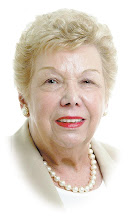
Guilford's library has been in good hands for many years

Once upon a time, a long time ago, in a pretty little town on the Connecticut shoreline, a nice lady by the name of Clarissa Sage left money in her will for a new library building. A generous gentleman, Mr. Frederick Spencer, contributed the land and finally on Aug. 5, 1933, the first shoveful of earth was removed by Martha Cornell of Church Street and that, dear readers, was the start of the Guilford Free Library.

If a library reflects a town’s hopes and dreams, then an amazing but modest 102-year-old woman, Edith Nettleton, who began as the library director in 1933 and served as the library’s director for 44 years until 1978, is as much part of the library as the bricks and mortar and architectural details of the beautiful building gracing the Green, today.

Due to the kind invitation of Nancy Elderbaum of Guilford, I recently was one of more than 100 guests on the latest of many honorary occasions; this one in celebration of Edith’s 102nd birthday. I am also indebted to Patti Baldwin, head of the Reference Department, for her help while researching this column.

Edith Nettleton has been described as an individual as rare as a rare book and her history as well as the fact that she still serves as a volunteer at the library several days a week, attest to that. She grew up in Guilford, starting school in a one-room schoolhouse on Clapboard Hill, then graduating from Guilford High School. Afterward, she went to Springfield, Mass., and became a librarian.

When the Guilford library association wrote and asked her if she could suggest someone to serve as the town’s first librarian, she responded, “How would I do?” and was promptly hired. At first, she and two volunteers not only served as the solitary staff during library hours (three days a week from 2-5 and 7-9) but they worked many additional hours when the library was closed, in order to get everything done; even driving many of the books each week to the Church Street school as the schools did not have their own libraries.

It is interesting to note that two other women have been instrumental in the growth of Guilford’s library. When Jean Baldwin moved to Guilford in 1952, she was dismayed to find that there were no school libraries for her three children so she joined the PTA and worked to establish a volunteer library at several of the schools.

In 1961, she used her considerable energy, talent and love of libraries by becoming Guilford’s associate librarian and eventually, upon Edith’s retirement, library director. Following Jean’s retirement in 1987, Sandy Ruoff, the present director, has continued to obtain the newest technologies and innovations while still retaining the warm, service-oriented appeal that is a hallmark of the library.

In 1960, the library Board of Directors created a development committee to estimate expansion needs. By 1964, the town population had grown from 3,000 to more than 8,000 and the library staff had grown from one full-time person to four. Hours the library was open each week had grown from 15 to more than 59.

Despite the obvious need to expand, the first plan proposed was turned down as being too modern.

The 1977 addition, designed by the Madison architect Gilbert Switzer added 15,000 square feet to the original 5,000-square-foot building and the latest addition in 2008 of 14,000 square feet. brings the total size to 34,000 square feet.

Of course, libraries today, in addition to an ever-increasing collection of books, now also house computers, records, films, art prints and serve as an advanced data base for information on a variety of subjects. They also act as lecture and entertainment centers for the community.

Edith Nettleton was the recipient of the inaugural Guilford Lions Club Award as Woman of the Year in 1972, was honored by the Whitfield Historic Society on the occasion of her 90th birthday, and in July of 2003, the library’s Guilford Room where she spent many hours cataloguing the bits and pieces of Guilford’s past, was re-named the Edith B. Nettleton Historical Room. The room features floor-to-ceiling glass bookcases, two fireplaces, window seats and wing chairs which face the arched windows overlooking the Guilford Green.

Guilford residents can take pride in their outstanding library and the woman who devoted her life’s work to helping it grow.

“Perhaps no place in any community is so totally democratic as the town library. The only entrance requirement is interest.” — Lady Bird Johnson

Every miscreant seems to have one goal - end up on reality TV

“The highest form of vanity is love of fame.” — George Santayana

The announcement that Michaele and Tareq Salahi, who made headlines in November by crashing President Obama’s first state dinner, were going to write a book about their experiences both caught my attention and left me feeling disgusted.

They are working with an investigative reporter and they will critique White House security. Although, as yet, there is no publisher, their book agent says many celebrity- or scandal-based books have been very successful. Adding to her attraction, Michaele has a starring role in an upcoming “Real Housewives of D.C.” reality TV series.

The entire episode might be so ridiculous as to be considered laughable were it not for the fact that it is no longer a unique occurrence. It seems to me that there is something seriously amiss in a society so in awe of attention that it rewards outrageous, even illegal, behavior with celebrity status.

Instead of being shunned or even fined or jailed, these two self-promoting zealots, who carefully planned and orchestrated their White House exploit down to the tiniest detail, are admired and rewarded. The media and general public seemingly applaud their lies and bravado. One of their ambitions (now achieved) was to get on a “reality show.”

My writer’s curiosity aroused, I did some research on “reality” shows and was astounded to learn that there are currently more than 300 different reality shows on television.

Donald Trump, who is a stellar example of a self-promoter, wants the recently jailed Lindsay Lohan on his “Celebrity Apprentice” show, just what this obviously troubled and already overexposed young actress does not need.

After appearing on “Dancing with the Stars,” Pamela Anderson, whose main attribute is most definitely not her dancing but her expansive bustline, gushed that “dancing changed my life.”

Then there’s “Dance Your Ass Off” and “The Biggest Loser,” two of many weight-loss based reality shows.

Paris Hilton has a show so insipid it is almost fascinating. In her “My New BFF” show, potential new best friends are put through tests of loyalty, endurance and compatibility. When one by one they are eliminated, Paris dismisses them with a snide smile and says, “TTYN,” which is her shorthand for “Talk to you never.” Can anyone over 14 years of age stomach this junk? We also have the “How many kids can you produce?” genre as exemplified by “19 Kids and Counting” and “Kate + 8.” At least their profits will go to help feed and support their families.

The “Jersey Shore” show, which some Jerseyites considered so distasteful that they mounted a protest, stars several scantily dressed, loud-mouthed types as they mostly drink, sunbathe and flirt. However, one of their “stars,” Jenni “JWoww” is “designing” a new clothing line to be distributed by Filthy Couture in Las Vegas. (Honest, I’m not making this up!)

Kim Kardashian, another buxom babe, is into her second perfume launch and has a wax replica at Madame Tussauds. These so-called reality show celebrities are so admired, their endorsements earn them additional big bucks in fields where they have absolutely no expertise, everything from clothes design to “authoring” a book.

There is also “America’s Next Top Model,” “America’s Top Dog,” “America’s Toughest Jobs,” “Sell This House,” “Secret Millionaire,” “Extreme Makeover” ... the list is endless.

Wikipedia informs us that the reality type of programming, which is purportedly unscripted dramatic or humorous situations featuring ordinary people, started with game shows in the 1940s.

About 1948, Allen Funt’s “Candid Camera,” followed by “Beat the Clock” and “Truth or Consequences,” became wildly popular. In 1973, the first real reality shows were introduced with PBS’ “An American Family,” which followed the daily lives of a family going through a divorce.

The 1950 series, “You Asked For It,” in which viewers’ requests dictated the content, was the forerunner of today’s audience-participation shows in which viewers cast votes to help determine winners and the course of events.

In many reality shows, participants are put into exotic or dangerous situations and coached to act in specific, scripted ways. Speech and events are manipulated to create an illusion of reality.

We can blame the Writer’s Guild of America strike and the subsequent need for new programming for the huge growth and popularity of the reality type of show. One such show is called, “Are You Smarter Than a 5th Grader?”

If Americans are satisfied with this type of programming, perhaps that answers the question.

Welcome to the 100,000-mile marital checkup

In a recent column, I talked about professor Jack Gesino’s views on how to learn to be happy. Since then, several other articles and books on the subject have come across my desk; perhaps it is as a result of wars, natural disasters and the economy, but it seems that research on, and advice about, being happy, is the new hot topic.

A federally financed study is following about 200 couples who will take part in a yearly marriage “checkup” ... similar to your preventative dental exam, it will attempt to discover any weak spots in the relationship.

The hope is that couples can make changes in the way they communicate so that problems can be solved before they sabotage the marriage. Since this is a computer-savvy generation, it should come as no surprise to learn that there are also several online programs that offer help to couples.

One online study is based on “acceptance therapy,” which focuses on better understanding of a partner’s flaws ... a skill which I long ago acquired and at which, any of the long-married couples pictured in the pages of this paper, must surely excel.

Perhaps this should be a skill learned in pre-marriage counseling; if we were aware of all of our partner’s flaws in advance, many ill-advised marriages might never take place. As a matter of fact, perhaps it would be the final blow to marriage as an institution.

According to author and lecturer, Maggie Scarf, marriage as an institution, has changed dramatically. I had the pleasure of personally chatting with Maggie, a research specialist on senior marriages, following her talk at the Institute for Learning in Retirement’s annual luncheon.

Scarf says, “since the social ferment of the 1960s, a number of alternatives to old-fashioned marriages have emerged: sexual partners living together; out-of-wedlock births; and single-parent child-rearing. All are now more commonplace and acceptable.

“Couples enter wedlock with a more light-hearted attitude (if it doesn’t work out, I can move on) and there is now little social stigma in the wake of a divorce. Paradoxically, it seems that the only people putting up a desperate fight for the right to get married are members of the gay community.”

What Scarf did find when she revisited the couples she had interviewed 20 years previously for her “Intimate Partners” book, was that for most of these senior couples, this was the happiest period of their lives. Career and child-rearing issues were over, their emotional processing and control was improved and since they were now more fully aware of the value of time, older adults arranged their days in ways that made them happier. She has reported on these senior couples in her book, “September Songs.”

I questioned what effect the current economy and loss of work opportunities for some older couples had on the marriages and she did admit that the majority of her happy couples were professionals from the New England area and were financially well off.

One interesting physical change as we age may also be responsible for why we feel happier. According to the Lifespan Laboratory in Stanford, Calif., the stress area of aging brains loses cells while there are positive changes in the frontal area of older brains that increase our sense of well being.

If you’ve gotten this far and still wonder how your marriage is doing, Brigham Young University offers an extensive online martial assessment called Relate. It reveals a couple’s communication and conflict styles and costs less than $50. For information, go to www.relate-institute.org.

As for me, assuming the unlikely luck of finding another compatible companion, after 56 years of ups and downs, I’m sticking with what I’ve got. The thought of re-adjusting to anyone else is simply too exhausting.

Contemplating the next bathing suit sends chills down the spine

The July 4th holiday brings picnics, parades and fireworks, but alas, it is also the official start of the bathing suit sales. Since I take an exercise swim class year-round, this is the time I must survey my bathing suit wardrobe and replace any suits that are deteriorating due to the effects of chlorine or shredding in strategic places.

This is annually the most embarrassing and thoroughly depressing procedure (second only to a colonoscopy) that I must endure.

I start by paging through the bathing suit catalogs to find out if my figure is an apple, triangle, pear or diamond. Unfortunately, it is all of these shapes with some unidentified additional problem areas.

My husband has worn the same pair of maroon trunks with drawstring waist for 10 years and his only worry are his knobby knees.

I have been trying to take solace in Carol Tuttle’s “Dressing Your Truth … Discover Your Personal Beauty Profile,” in which she states that every woman is innately beautiful. By learning your personal “Beauty Profile,” you can start dressing your truth.

Tuttle is an alternative psycho-therapist who helps to empower women to make fashion and beauty choices in harmony with their personal Beauty Profile, expressing the true nature of who they are. While her book is interesting and helpful, she is a psycho-coward because nowhere does she mention the bathing suit ordeal.

I defy any woman older than 25 with a less-than-perfect figure and traces of cellulite, to stand in front of a four-way mirror lighted by industrial strength, fluorescents, surrounded by pricey bathing suits the size of a newborn’s diaper, to feel supremely confident. In her book, Carol describes, in great detail, the four basic types of women:

1. Bright, Animated

2. Subtle and Soft

3. Rich, Dynamic

4. Bold and Striking

In reading all the descriptions, including the kind of childhood you had, although the author states that you really can be only one type, I felt I fell squarely between a bright and animated and a rich and dynamic. I have always favored colorful classics made distinctive by their good fabrics and tailoring details, but my age and additional weight have added considerations I did not have to think about in my 30s and 40s.

Perhaps my new, basic style would best be described as “Matronly Optimistic.” Men and their personality types are never mentioned; perhaps it is because all the retired men I know fit nicely into one classification:

1. Casual to Sloppy

Val has never had to concern himself about dressing to reflect his inner persona. Indeed, he doesn’t even worry as I do about what to wear for a special occasion, planned for, say, late September. My self-conversation in front of my closet dismisses the good white dress as too summery, the black sleeveless as ideal, but we could be seated under an air-conditioning vent and I’ll get chilblains, and the turquoise sheath with jacket is getting tight in the hips and anyway the matching shoes hurt my feet.

Val, an hour before the event, will pull out of the plastic garment bag his navy jacket and khaki trousers and never even get upset over the fact that all the other men at the event will be wearing the exact same thing.

Although I seldom buy clothes that I don’t like or rarely wear, for women who haven’t as yet, developed a personal style, Carol Tuttle’s book offers a lot more practical advice than the “What Not to Wear” television show or the several-hundred-dollar-a-day closet experts.

For more, go to Carol Tuttle’s http://dressingyourtruth.com/.